 1-3 HRS
KTM Dirt Bike
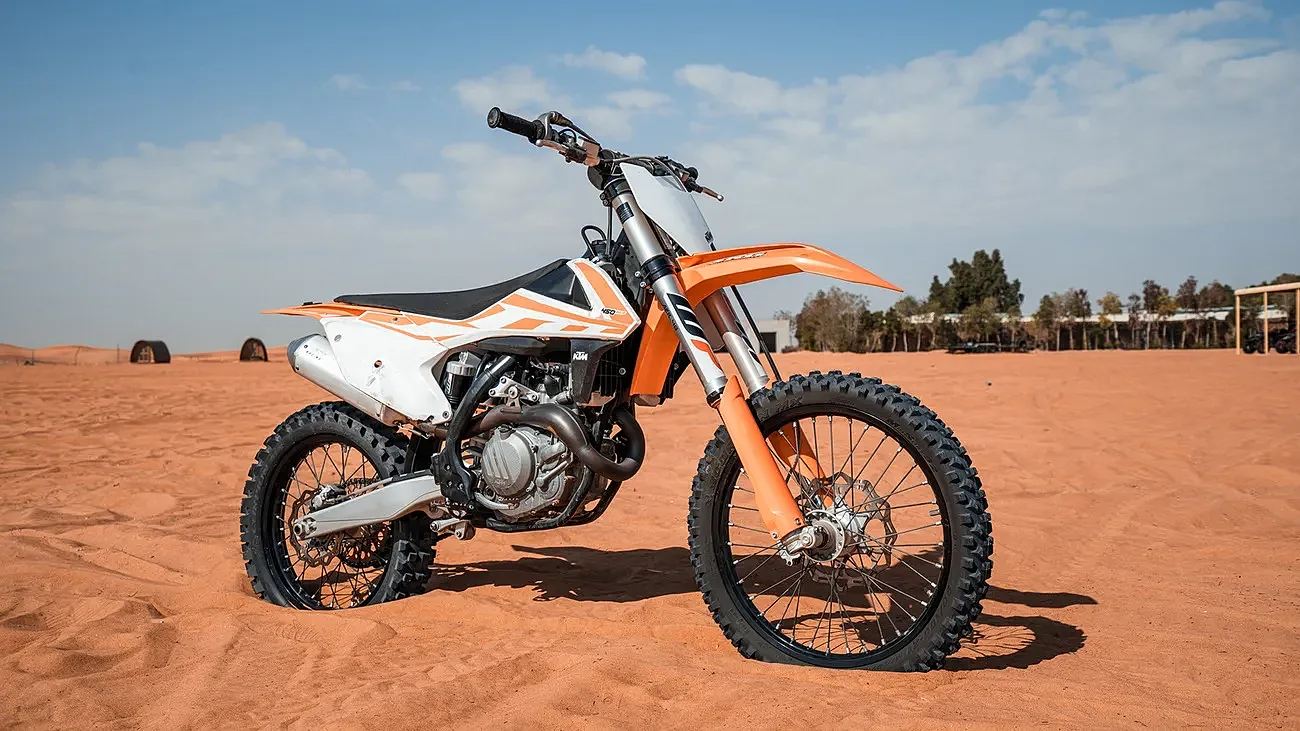
KTM 450 CC Dirt Bike
Helmet & safety gear included · Licensed and insured guide · 1, 2 or 3-hour sessions
Book Online
Home · KTM Dirt Bike
Throw a leg over a genuine KTM 450cc and carve through Al Lahbab's red dunes on your own two wheels, guided by a licensed and insured Dubai team.
1 experience · Book Online · 1-3 hrsKTM dirt bike riding in Dubai puts you on a genuine KTM 450cc off-road motorcycle out on the open dunes near Al Lahbab, not a shared buggy or a quad you steer with your knees. You book by the hour, choosing 1, 2, or 3 hours, and a licensed and insured local team briefs you on the bike, the terrain, and the safety gear before you roll out. Pricing depends on your session length and group size, so it's quoted directly on WhatsApp rather than listed as a fixed rate.
The riding grounds sit among the same red dune belt that draws dune buggy and quad bike riders out past Al Sufouh, open desert with real elevation, soft crests, and enough space to open the throttle without weaving around tour traffic. Because a KTM 450cc demands more control than a quad, sessions run with a guide who checks your line before letting you push speed, and most riders wrap up their hour, or three, with a stop at a Bedouin-style camp nearby for a breather and a cold drink. It's the closest thing to real enduro riding inside Dubai's city limits, run by a team licensed and insured for exactly this kind of desert motorsport.
1-3 HRS
KTM Dirt Bike
Helmet & safety gear included · Licensed and insured guide · 1, 2 or 3-hour sessions
Excellent rating
Based on 1,428 Google reviews
Excellent rating
Based on 917 reviews
Common Questions
The Complete 2026 Guide
Yes, you can ride a real KTM 450 dirt bike in the Dubai desert. Safari Desert Dubai runs guide-led sessions of 1, 2 or 3 hours across the Al Lahbab red dunes, with helmet and safety gear included. Pricing is quoted per rider on WhatsApp (+971 52 440 9525) based on duration, experience and group size, and secure online advance payment confirms your booking.
1 Hour
First Sand Session
The right call for your first time on sand. Long enough to learn the technique, short enough that your arms forgive you.
2 Hours
The Confident Middle
Sand technique usually clicks around the 45-minute mark. The second hour is where the dunes start to feel like play.
3 Hours
Full Endurance Ride
For fit riders with real dirt experience. You go deeper into the dune ranges, with rest stops paced around your stamina.
The Bike
KTM 450 CC
A proper motocross machine, not a softened rental. Light, sharp and quick to respond in soft sand.
Terrain
Al Lahbab Red Dunes
Open red sand about 45 minutes from the city. No track markers, just dunes that change shape with the wind.
Pricing
Quoted Per Rider
No fixed rate card. Your price depends on duration, experience and group size, and one WhatsApp message gets you a firm number.
Yes. Safari Desert Dubai runs guided KTM 450 dirt bike sessions in the Al Lahbab red dunes, about 45 minutes from the city. You ride your own bike behind an experienced lead rider, in sessions of one, two or three hours.
Desert dirt biking is fully open to visitors in Dubai, and it happens on real sand rather than a groomed practice loop. Safari Desert Dubai runs its KTM 450 sessions in the Al Lahbab red dunes on the city's eastern edge, roughly 45 minutes from most hotels. This is the same dune belt the safari convoys use, but you ride away from the tourist circuits, on open sand, behind a guide who knows the ground by heart. Each rider gets their own bike. Sessions run for one, two or three hours, and the company holds a Dubai tour operator licence, so the whole thing happens inside a legal, insured framework.
The format is guide-led rather than free-roam, which is how responsible desert riding works across the UAE. You arrive, gear up, sit through a proper briefing, then follow your guide into the dunes. He sets lines that match your ability, watches how you handle the first few slopes, and opens up the pace as you settle. Strong riders get bigger dunes and longer runs. Riders finding their feet get kinder terrain until they are ready for more. Nobody gets dropped, and nobody gets pushed onto sand they cannot handle, which is what keeps the ride fun instead of frightening.
The KTM 450 is a genuine motocross machine, so this suits riders who have spent time on two wheels before, even if that time was on roads or trails rather than sand. You do not need racing credentials. You do need clutch control, balance at low speed and the honesty to describe your level accurately when you book. If you have never ridden a geared motorcycle at all, an automatic quad is a far better introduction to the desert. Our quad bike tours run in the same dunes and take complete beginners, with machines from kids-size upward.
Everything runs around your schedule rather than a fixed departure board. Sessions go out through the day, support is available 24/7 on WhatsApp, and the team operates from Al Sufouh 2 in Dubai. You bring yourself, suitable clothing and a water bottle; the bike, fuel and safety kit are waiting when you arrive. The whole experience sits closer to a private coaching ride than a theme park queue, which is what a machine like the 450 deserves. Book a morning slot in the warmer months and you get cool sand, soft light and dunes freshly reshaped by the overnight wind.
Sand gives you almost none of the grip a track does, so everything changes. You sit further back, stand up more, brake far less and trust momentum to carry you through the soft sections. Riders who arrive with track habits usually spend the first twenty minutes unlearning them.
The first thing sand does is attack your front wheel. On hardpack the front end bites and steers; in the dunes it wants to knife in and wash out the moment you load it. Desert riding shifts your weight rearward and keeps the throttle steady, letting the back wheel drive while the front floats. Chopping the throttle is the classic first-timer mistake, because slowing down makes the bike sink and the sink makes the bars twitch. Smooth, committed inputs keep the KTM planing across the surface the way a boat planes across water, and once you feel that float happen, the whole desert opens up.
Body position matters more here than almost anywhere else you will ride. Standing on the pegs with bent knees turns your legs into suspension and lets the bike move underneath you, which it constantly wants to do in soft sand. Grip with your knees, keep your arms loose and look far ahead instead of at your front fender. Sitting down feels safer to beginners and is usually the opposite, because it locks your weight into every wobble the sand transmits. Your guide covers this in the briefing, then reminds you again on the first slope, because everyone forgets it the moment the surface moves.
A track gives you braking markers, berms and the same corner every lap. The desert gives you terrain that changed shape overnight. Wind rebuilds dune faces daily, so reading sand becomes the real skill: spotting the rippled, firmer patches, respecting the soft bowls on the shadow side, and never cresting a dune at speed without knowing what sits behind it. Momentum is your currency. Carry enough and soft sections pass underneath you; lose it halfway up a slip face and you will be digging. Your guide picks lines that keep you rolling, which is half the value of riding behind someone who covers this ground every week.
Then there is the workload. Twenty minutes of dune riding works your forearms, shoulders and legs harder than a full session on hardpack, because the bike never stops moving under you and the throttle rarely closes. This surprises fit riders and humbles gym-strong ones. It is also why session length matters so much when you book, and why the team asks about your riding background before quoting. None of this should put you off. Sand is the most forgiving surface there is to fall on, and the learning curve is fast when someone experienced is choosing your terrain.
Three things shape your first session: arriving reasonably fit, describing your real riding experience when you book, and taking the briefing seriously. Get those right and the desert does the rest.
Be honest with yourself about fitness first. You do not need to be an athlete, but sand riding is cardio with a throttle, and your forearms, core and legs are recruited from the first minute. If you can manage a solid half hour of physical work without stopping, an hour on the KTM is within reach. Riders who arrive after a heavy night or on an empty stomach feel it fast. Sleep properly, eat something light beforehand and start hydrating the day before your session rather than in the car park, because the desert pulls water out of you quicker than you notice.
When you message the team, tell them your actual riding history, not the version that sounds good. Years on a road bike, a few motocross sessions as a teenager, regular trail riding, whatever it is, the truth shapes everything: the pace your guide sets, the terrain he picks and the duration he recommends. Overstating your level buys you a first hour spent scared on sand you are not ready for. Understating it wastes the ride. There is no judgement either way. The guides have taken everyone from nervous first-timers to seasoned racers into these dunes, and they calibrate to whoever shows up.
The briefing is short but it is not a formality. You cover throttle discipline in soft sand, body position, how the guide communicates on the move, and what to do when you drop the bike, which most first-timers do at least once, slowly and at walking pace. Ask questions. Guides would far rather explain something twice in the shade than untangle confusion out on a dune face. If anything about the bike feels unclear, the clutch, the brakes, the stand-up position, say so before the wheels roll. Five extra minutes at the start is the cheapest confidence you will ever buy.
A few practical notes to finish. Book morning slots between May and September, because summer afternoons are brutal for physical riding. Leave jewellery and anything loose at your hotel. Bring sunglasses for before and after, sunscreen for your neck and hands, and a spare shirt, because you finish soaked in any season. The small logistical answers, meeting point, timings, what happens on the rare rainy day, live on our FAQ page, and the team answers fast on WhatsApp if you would rather ask a person.
Every KTM session includes a helmet, goggles and the core safety kit, fitted and checked before you ride. You look after the layer underneath: long sleeves, long trousers and sturdy closed shoes that cover your ankles.
The provided gear starts with a proper helmet, sized on arrival rather than grabbed from a pile, plus riding goggles that seal against the dust you will absolutely generate. The protective kit for the ride comes with the bike, and everything gets checked before you set off. If a strap feels wrong or a fit feels off, say so and it gets swapped. For the exact protection issued with your session, ask when you request your quote; the answer comes quicker and more precisely from the team on WhatsApp than from any webpage, and it can vary with what you are booking.
What you wear underneath matters more than people expect. Go for a breathable long-sleeved top and full-length trousers, ideally in fabric that survives a slide on sand, so jeans or riding pants over gym leggings. Shoes must be closed, sturdy and ankle-covering: trainers work at a minimum, hiking boots are better, and sandals end the conversation before it starts. Skip loose scarves and anything that can catch. Sand finds every gap in your clothing within minutes, so snug cuffs and a tucked-in top save you from carrying half of Al Lahbab home in your waistband.
If you own motocross gear, bring it. Your own boots, pressure suit, knee braces or gloves will always fit better than anything issued, and the team is happy for experienced riders to kit up in their own equipment. Mention it when you book so they know what to set aside. Riders who fly in for this often pack boots in their hold luggage and borrow the rest, which is a sensible split, since boots are the one item where personal fit changes your riding most.
Two small habits make the desert kinder. First, sun: even in the cooler months the UAE sun works on you constantly, so sunscreen on your neck, ears and hands before you gear up is worth the thirty seconds. Second, sand in electronics: phones ride safest zipped in a pocket or left with a spectator, and a camera stays sealed until you actually want it. A light neck buff under the helmet keeps dust out of your nose and doubles as sun cover during breaks. None of this is mandatory. All of it is what the guides themselves do.
One hour suits first-timers and road riders new to sand, two hours is the sweet spot for anyone with dirt experience, and three hours is for fit riders who want real distance. When in doubt, book shorter. Tired riding is sloppy riding.
The one-hour session is honest about what first-timers have in the tank. Sand loads your forearms and legs from the first minute, and most people new to it are pleasantly wrecked by minute fifty. An hour gives you the briefing put into practice, a real taste of dune craft and a finish line that arrives before fatigue turns into mistakes. Road riders trying sand for the first time almost always belong here, whatever their years in the saddle, because the technique differs enough that experience on tarmac only partly transfers.
Two hours is where the ratio gets good for riders with some dirt background. The odd thing about sand technique is that it clicks somewhere around the 45-minute mark: the front end stops scaring you, the throttle hand relaxes and the bike starts to float instead of fight. Book a single hour and you go home at the exact moment riding starts to feel good. The second hour is spent riding rather than adapting, with bigger dune faces, longer runs and a guide who now knows what you can take. If you are torn between one and two, your dirt history is the tiebreaker.
The three-hour ride is an endurance session and should be treated with respect. It suits riders who train regularly, have real motocross or enduro miles behind them and want to get deep into the dune ranges rather than lapping the accessible edges. The pace includes rest stops, because nobody rides sand for three hours straight, but the cumulative workload is real, and the final hour rewards riders who paced themselves through the first. If that description made you grin, this is your booking. If it made you calculate, take the two-hour ride and come back hungry.
Still unsure? Say so in your message. Give the team your riding background and fitness honestly and let them recommend a duration; they place riders every week and their read is better than your guess. And if the physical demands here sound like the wrong kind of fun, the desert has gentler ways to hand you power. Our dune buggy tours put the same red dunes under a roll cage, with a seat for a passenger and none of the toll on your arms.
Message the team on WhatsApp at +971 52 440 9525 with your preferred date, the session length you want and how many riders are coming. You get a clear per-rider quote, and support runs 24/7.
Three factors shape a KTM quote. Duration is the biggest lever, since one, two and three-hour sessions carry different rates. Experience level matters because it affects the guiding arrangement and the terrain your session needs. Group size changes the numbers too, since several riders sharing a slot are priced differently from a solo booking. This is why the site publishes no fixed rate card for the 450: a single number that ignored those three things would be wrong for most of the people reading it. Send your details, get the real figure and decide with actual information in hand.
The booking flow is short. Message on WhatsApp or send the form on our contact page, the team confirms availability for your date and answers whatever else you want to know, and your quote follows. Secure online advance payment confirms your booking and locks your slot, which keeps the day's schedule running on time for everyone. Confirmation lands within 48 hours, usually much sooner, with your meeting point and timing details. From there the only things left to organise are what you will wear and how early you can talk yourself into sleeping the night before.
Plans change, and the cancellation terms are plain. Cancel more than 96 hours before your ride and you are refunded in full. Between 24 and 96 hours, half comes back. Inside 24 hours there is no refund, because that bike and that guide were held for you. Groups of four or more riders work on a longer timeline, with tiers at seven and five days out. The complete terms sit on our refund policy page, and they are worth the two-minute read before you pay rather than after, especially for groups with moving travel dates.
One last thought for mixed groups: the KTM is a rider's booking, but nobody has to wait in the car park. Partners and friends who do not ride can join a desert safari or a camel experience running in the same dune belt, then meet you afterwards with photos of your dust trail. Mention the whole group's plans in your first message and the team lines up timings so everyone's day fits together. That first WhatsApp message costs nothing and commits you to nothing. The dunes at Al Lahbab will still be there tomorrow, but your trip dates will not wait forever.
People also search for
Guide FAQs
Tell the team your ride length and group size on +971 52 447 2719 and get a straight price back. No fixed listing, no guesswork.