 FAMILY PICK
20-25 MIN
FAMILY PICK
20-25 MIN
Camel Ride
Camel Ride Desert Dubai
Experienced handler on lead rope · Photo stop at the dune ridge · Suitable for kids, seniors and beginners
Book Online
Home · Camel Ride
A smooth, guided ride across Al Lahbab's red dunes, paced gently enough for grandparents, toddlers, and everyone in between.
1 experience · Book Online · 20-25 minA camel ride in Dubai's desert takes about 20 to 25 minutes, led on a rope by an experienced handler while you sit in the saddle and take in the dunes at walking pace. It's the slowest, gentlest activity we offer, with no driving skills or adrenaline needed, just the camel's steady rock-and-sway rhythm under the open sky. Kids, grandparents, and first-time desert visitors all ride comfortably, and the handler stays with you the whole way.
The ride sets off from our desert camp in Al Lahbab, among the same red dunes Dubai's Bedouin once crossed by camel caravan. Book it on its own, or add it to a morning or evening desert safari at the same Bedouin-style camp. Either way, you're booking through a licensed and insured desert operator, so if you're searching for a camel ride near me, you can book with confidence. Message us on WhatsApp with your date and group size and we'll confirm the price, along with pickup details across Dubai, including Al Sufouh, when it's combined with a safari.
FAMILY PICK
20-25 MIN
Camel Ride
Experienced handler on lead rope · Photo stop at the dune ridge · Suitable for kids, seniors and beginners
Excellent rating
Based on 1,428 Google reviews
Excellent rating
Based on 917 reviews
Common Questions
The Complete 2026 Guide
A camel ride in Dubai with Safari Desert Dubai is a 20 to 25 minute handler-led ride through the Al Lahbab red dunes, bookable on its own or as part of a safari. Standalone rides are priced on request over WhatsApp (+971 52 440 9525), while the Morning Desert Safari from AED 225 per person includes a camel ride alongside dune bashing and sandboarding. Secure online advance payment confirms your booking, with written confirmation within 48 hours.
Standalone ride
Classic Camel Ride
20 to 25 minutes through the Al Lahbab red dunes with a handler on foot the whole way. Priced on request; WhatsApp +971 52 440 9525 for a quote.
From AED 225
Morning Safari + Camel
Land Cruiser dune bashing, sandboarding and a camel ride in one morning. The easiest way to ride without a separate booking.
From AED 290
Morning Safari + ATV + Camel
The same morning safari plus 30 minutes on an ATV, minimum two people. The camel ride still comes built in.
From AED 1,149
Deluxe Balloon + Camel
Sunrise flight followed by breakfast, falconry and a camel ride before drop-off. Seasonal, roughly October to April.
Families
First Ride for Kids
Handlers walk beside every camel at a slow pace, so young riders settle fast. A gentle pick for mixed-age groups.
Groups of 4+
Private Group Rides
Bigger parties get one combined quote and their own cancellation tiers. Tell us your headcount on WhatsApp and we price it as a single booking.
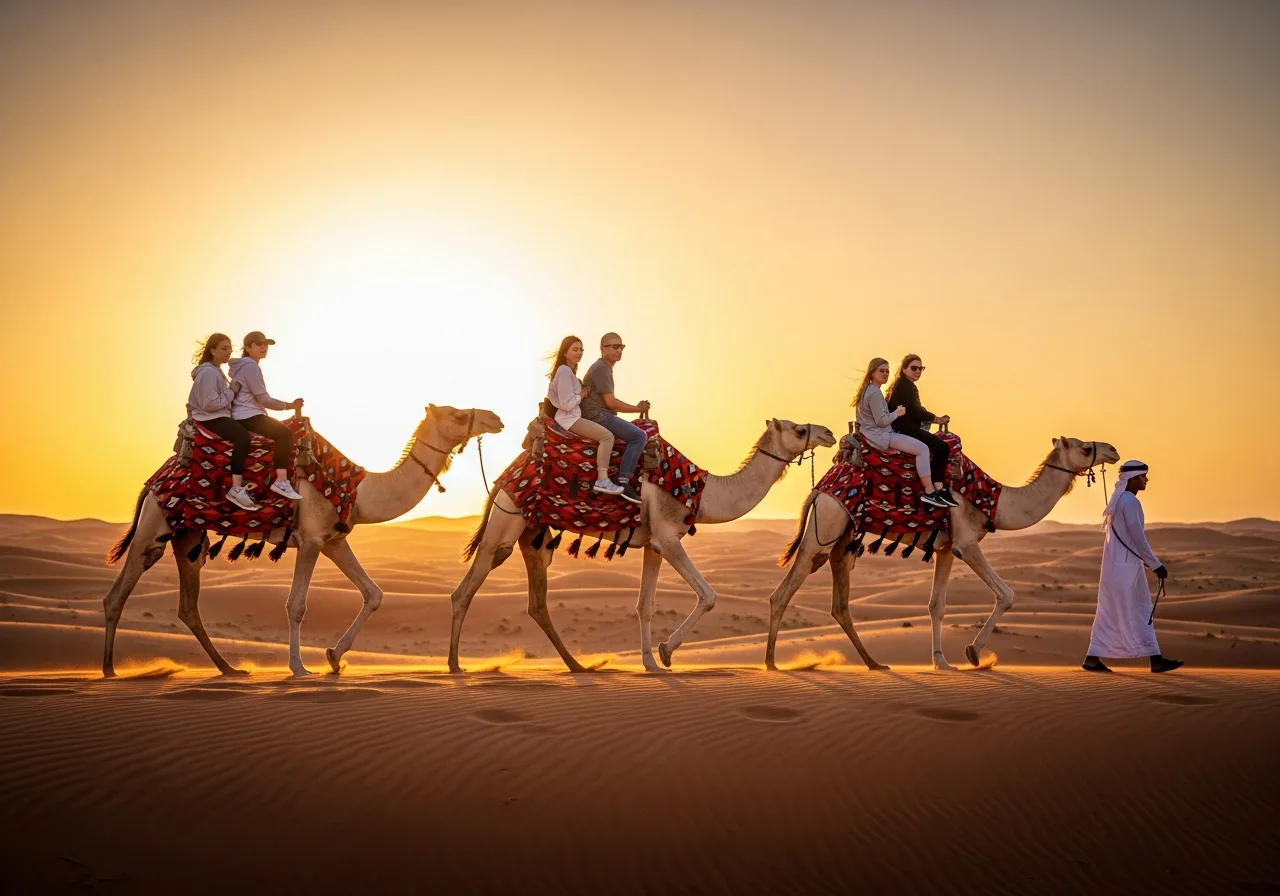
A camel ride with Safari Desert Dubai is a 20 to 25 minute walk through the Al Lahbab red dunes on a saddled camel, with a handler leading on foot the whole way. The pace is slow and steady, and you sit around two metres above the sand.
The ride happens out in Al Lahbab, the stretch of red dunes about 45 minutes from central Dubai where our safaris run. When you arrive, your camel is already saddled and resting on the sand, legs folded beneath it. A handler introduces you, shows you where to hold, and helps you settle into the padded seat. Camels are bigger than most first-timers expect. Standing, they put you roughly two metres above the ground, which is why you board while the animal is kneeling. Take a moment before the stand-up. Get your grip right, sit back in the saddle, and let the handler give the cue when you're ready.
Once you're up, the pace is a slow, rolling walk, around the speed of a relaxed human stroll. Camels move both legs on the same side together, which creates a distinct sway, side to side rather than the up-and-down bounce of a horse. It takes about a minute to stop fighting it. Loosen your hips, let your body move with the animal, and the rhythm becomes comfortable, almost sleepy. The full ride runs 20 to 25 minutes, long enough to crest a few dunes and feel the quiet of the open desert, short enough that nobody gets sore. Your handler stays on foot beside you the entire time.
The height is the part people talk about afterwards. Two metres doesn't sound like much until you're up there, watching the dune ridges roll out in every direction with nothing mechanical between you and the sand. There's no engine noise, no vibration. You hear the camel's feet pressing into the sand, wind moving over the ridges, and little else. Riders who've done dune bashing earlier in the day often say this is the moment the desert registers. From the saddle you notice things you miss from a 4x4 window: beetle tracks, the shifting colour of the sand, how the dunes change shape as the light moves.
No skill is asked of you at any point. The handler controls the camel, sets the route, and watches how you're sitting. Your jobs are to hold the saddle handle, lean the right way during stand-up and sit-down, and enjoy the ride. That makes this the calmest activity we run, suited to guests who want the desert without noise or speed. Grandparents ride alongside grandchildren. Couples ride side by side on separate camels. If anyone in your group feels unsure halfway through, the handler can stop, steady the animal, and help them down. Nothing about the ride is rushed, and that's deliberate.
Camels made life in this desert possible. For centuries they were transport, food, wealth and companionship for Bedouin families, and that history is why a slow ride through the dunes still carries meaning here.
The old name, ships of the desert, was earned rather than invented for brochures. A camel can cross distances that would finish a horse, going days without water and carrying loads through soft sand that swallows wheels and hooves alike. The hump, contrary to the myth, stores fat rather than water; it's an energy reserve that let caravans push between wells across the Empty Quarter. Wide, padded feet spread the animal's weight so it walks on top of dunes instead of sinking in. Before roads, before the union, before oil, this was how people, goods and news moved across the Arabian Peninsula.
For Bedouin families, a camel was closer to a livelihood than a pet. Camel milk was daily nutrition in places where little else grew. Hair was woven into tents, rugs and rope. A strong female was a serious asset, given as a dowry, settled in disputes, passed down through generations. A family's herd was, in practical terms, its bank account. The animals were named, recognised by their footprints, and praised in Nabati poetry that Emiratis still recite today. The care our handlers show their camels comes straight out of that tradition, and it's part of why the ride feels unhurried from start to finish.
The camel never faded into history here; it moved into new roles. Racing is a major sport in the UAE, with purpose-bred camels training on dedicated tracks outside Dubai and robot jockeys long since replacing riders. Beauty contests such as the Al Dhafra festival draw owners from across the Gulf, with serious prize money for the finest animals. Camel milk sits on ordinary supermarket shelves, and camel milk chocolate has become a favourite gift to carry home. So when you ride at Al Lahbab, you're meeting an animal that still has a place in daily Emirati life, not a relic kept for tourist photos.
A little respect goes a long way during your visit. Approach the camel from the side where the handler stands, ask before touching, and skip the flash if you're photographing its face up close. The animals work short, managed sessions with rest and water between rides, and a handler will end one early if a camel shows signs of stress. Guests sometimes ask why the ride is only 20 to 25 minutes. Part of the answer is your comfort, since saddle time adds up fast for new riders, and part of it is the camel's welfare. Both halves of that equation matter to us.
Both slots have a case. Sunrise is cooler and quieter with soft, even light, while sunset turns the red dunes copper and pairs well with an evening at the camp. Photographers tend to love the morning; most guests pick sunset for the colour.
Morning rides start early for a reason. The desert holds its overnight cool for a few hours after dawn, so the air is fresh, the sand is cold underfoot, and the camels are at their liveliest. Light at that hour is soft and low, raking across the dunes and throwing long shadows that give your photos depth without any editing. The dunes themselves are at their cleanest, since overnight wind erases yesterday's footprints and tyre tracks. You'll often spot fresh prints from desert life that passed through before sunrise. If you like calm and dislike crowds, morning is your slot, and it leaves the rest of the day free.
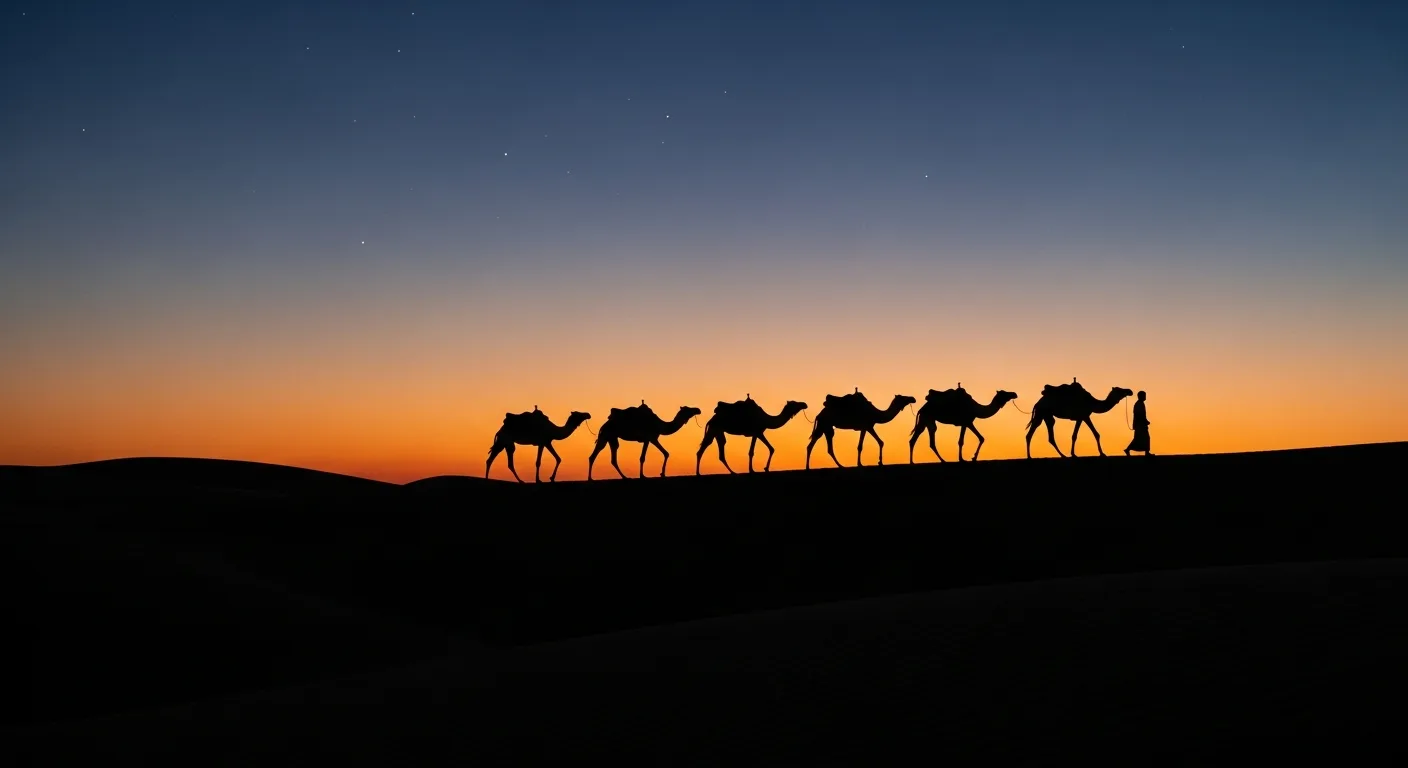
Sunset is the classic choice, and the red sand of Al Lahbab is the reason. In the last hour of daylight the dunes shift from rust to copper to a deep burnt orange, and the low sun makes every ridge glow along its crest. The air cools quickly as the sun drops, so the ride finishes in pleasant temperatures even in the warmer months. There's also the simple pleasure of what comes after: pair the ride with an evening at the desert camp and you step off the camel as the first stars appear and dinner is being prepared behind you.
We schedule rides around the cooler ends of the day, and between May and September that matters, since the open desert regularly passes 40 degrees with no shade on a dune. Whatever slot you choose, a few photo habits help. Shoot with the sun to one side rather than behind you, so the dune texture shows. Ask your handler to pause on a ridge line for a silhouette shot; they know the angles because they're asked daily. Then put the phone away for at least part of the ride. The sway, the quiet and the light are better lived than framed.
Season shifts the answer slightly. From November to March, Dubai's winter, both slots are comfortable, so choose purely on light and mood. In summer, commit to early morning or the final hour before sunset, and bring water either way. And if you want to see dawn over the dunes from the air first, our hot air balloon flights lift off before sunrise between roughly October and April, with a camel ride included in the Deluxe package after landing. Plenty of guests do both in one trip: dunes from the sky one morning, dunes from a saddle the next evening.
Wear loose, breathable clothing that covers your legs, closed shoes that won't slip off, and sun protection for your head and eyes. Modest dress is appreciated in the UAE and happens to be exactly what desert conditions call for anyway.
Start with your legs, because they do the most work against the saddle. Long, loose trousers or thick leggings prevent the rubbing that shorts guarantee on a 20 minute ride, and they protect your skin from sun and from camel hair, which irritates some people on contact. Skip slippery fabrics like gym shorts or silky trousers, since a smooth seat on a smooth saddle is a poor combination during the stand-up lurch. Skirts and dresses fight the leg-over mount, so save those for the camp photos afterwards. Jeans work fine in winter but get uncomfortably hot from April onward, when lightweight cotton or linen earns its keep.
Up top, a light long-sleeved shirt beats a vest in almost every season, since desert sun burns quickly and reflected light off the sand catches you from below as well. Sunglasses are close to essential. Choose a cap or hat that fits snugly or has a chin cord, because ridge lines are breezy and nobody enjoys watching their hat cartwheel down a dune from camel height. A light scarf or shemagh earns its place on windy days, covering your neck and doubling as a face shield if the sand kicks up. From November to February, evening rides get properly cool, so pack a warm layer.
Footwear matters more than people expect. Closed trainers or shoes with a heel strap are ideal. Flip flops are the classic mistake: they drop off mid-mount, and retrieving them means someone digging in the sand while your camel waits. Sand temperature swings hard out here, hot enough to sting bare feet on summer afternoons and cold on winter mornings, so you want that barrier either way. Socks are worth wearing too, since fine red sand finds its way into everything. If you're coming straight from the pool or beach, take two minutes to change; wet swimwear plus saddle friction is a lesson you only learn once.
Last, think about what's in your pockets. The mount and dismount tilt you forward and back at angles your phone hasn't met before, and shallow pockets empty themselves into the sand. Zipped pockets or a small cross-body bag solve it. Keep one hand free at all times for the saddle handle, so wrist straps beat handheld grips for cameras. Leave dangling jewellery and sunglasses perched on your head at the hotel. Everything you drop is findable in theory, but red dunes are excellent at hiding small dark objects, and your handler's job is leading a camel, not metal detecting.
You board while the camel is kneeling on the sand, then hold on as it stands rear legs first, which tips you forward and then back over about five seconds. Your handler cues every step and steadies you throughout. Getting off is the same sequence in reverse.
Mounting starts with the camel couched, which means kneeling with its legs folded underneath. Your handler holds the animal steady while you swing a leg over the saddle, the same motion as getting on a bicycle, just wider. Sit well back into the seat, put both hands on the saddle handle in front of you, and press your legs lightly against the saddle's sides. Don't grab the camel's neck or hump; the handle exists precisely so you never need to. Once you're settled, tell the handler you're ready. Nothing happens until you say so, which is worth knowing if you're nervous about the next part.
Then comes the moment every first-timer remembers: the stand-up. Camels rise back legs first, which pitches you sharply forward, then the front legs straighten and swing you the other way. It feels dramatic and lasts about five seconds. The technique is simple. Lean back as the camel starts to rise, stay leaning back through the forward pitch, then come upright as the front end lifts. Your handler calls it out before it happens, and most people laugh their way through it. Honestly, that lurch is the most exciting part of the whole ride, and it's over before you've finished your sharp intake of breath.
During the ride itself, your job is mostly to relax. Gripping hard with your legs or locking your arms makes the sway feel worse, the same way tensing up on a boat brings seasickness on faster. Keep a light hold on the handle, let your hips move with the camel's rhythm, and breathe. You don't steer; there are no reins in your hands, and the handler leads from the ground. If you feel unbalanced at any point, say so. Handlers can pause the camel on flat ground within a few steps and adjust your position, and they'd rather do that than have you white-knuckle the rest of the ride.
Dismounting reverses the sequence. The handler brings the camel to a stop and cues it down; the front legs fold first this time, tipping you forward again, then the back end lowers and you're level. Lean back as it kneels, exactly as you did for the stand-up, and wait for the full stop before moving. Swing your leg back over, and take the handler's arm if it's offered, since your legs may feel briefly wobbly after 25 minutes of swaying. Step away on the handler's side of the animal. If you have more safety questions before booking, our FAQ page covers the common ones.
Yes, and it's the most common way people ride. The Morning Desert Safari at AED 225 per person includes a camel ride alongside dune bashing and sandboarding, the Deluxe balloon package includes one after landing, and standalone camel rides are quoted individually on WhatsApp.
The simplest combination is our Morning Desert Safari with Land Cruiser 4X4 at AED 225 per person, which fits a 20 to 25 minute dune bash, sandboarding and a camel ride into a single morning. Want more throttle in the mix? The AED 290 version adds 30 minutes on an ATV, with a two-person minimum. Either way the camel ride comes built in, with no separate booking and no extra quote. If your trip is short and you want the desert's greatest hits in one outing, this is the booking we point most first-time visitors toward.
Sunrise chasers can fold a camel ride into a balloon morning instead. The Deluxe hot air balloon package at AED 1,149 follows your 45 to 60 minute flight with breakfast, a falconry display and a camel ride before the 9:30 to 10 AM drop-off. The Premium package at AED 1,349 goes further, adding a morning desert safari, 30 minutes on a quad bike and a camel or horse ride. Balloon flights are seasonal, running roughly October through April, with pickups between 3:45 and 4:30 AM. It makes for a long morning, and guests consistently tell us it was the best one of their trip.
Evening works too. The Evening Desert Safari with BBQ Dinner runs six hours at AED 240 per person; ask us when booking and we'll quote a camel ride alongside it as one combined package. Some guests deliberately build a contrast day: a loud, fast session on quads or a dune buggy first, then the camel ride as the slow, quiet closer. It works because the two show you different deserts. One is about the machine. The other is about the animal and the quiet. Doing both in one trip is the closest thing we offer to a complete picture of Al Lahbab.
Standalone camel rides are priced on request rather than listed, because group size, timing and extras change the quote. Getting one is quick: message +971 52 440 9525 on WhatsApp with your preferred date, headcount and morning or evening, and we'll come back with a price. Prefer a form? Send the same details through our contact page and the same team responds. Once you accept the quote, secure online advance payment confirms your booking, and written confirmation follows within 48 hours. Support runs 24/7, so a question at midnight before a dawn ride still gets answered. Cancellation terms are on our refund policy page.
People also search for
Guide FAQs
WhatsApp +971 52 440 9525 with your date and group size, and we'll confirm price, timing, and pickup details directly.